
Role
Outcome
Production StoreKit 2 migration shipped
Stack
Objective-C · Objective-C++ · C++ · Swift · UIKit
What this proves
Selected work from the build
- Migrated a legacy multi-target app suite to StoreKit 2
- Restored lifetime access for paid-app legacy users after a freemium migration
- Added Firebase Analytics and plist-driven catalog color metadata
Visuals
Product walkthrough
Tap or click the preview to open it fullscreen.
Case study
A closer look at the problem, implementation choices, and outcome.
Quick facts
- Role: StoreKit 2 migration owner, entitlement/debugging owner, project cleanup support
- Timeframe: February-April 2026
- Platform: Multi-target native iOS app suite
- Status: Production StoreKit 2 migration shipped
- Team: Solo modernization engineer working with client testing feedback
Context
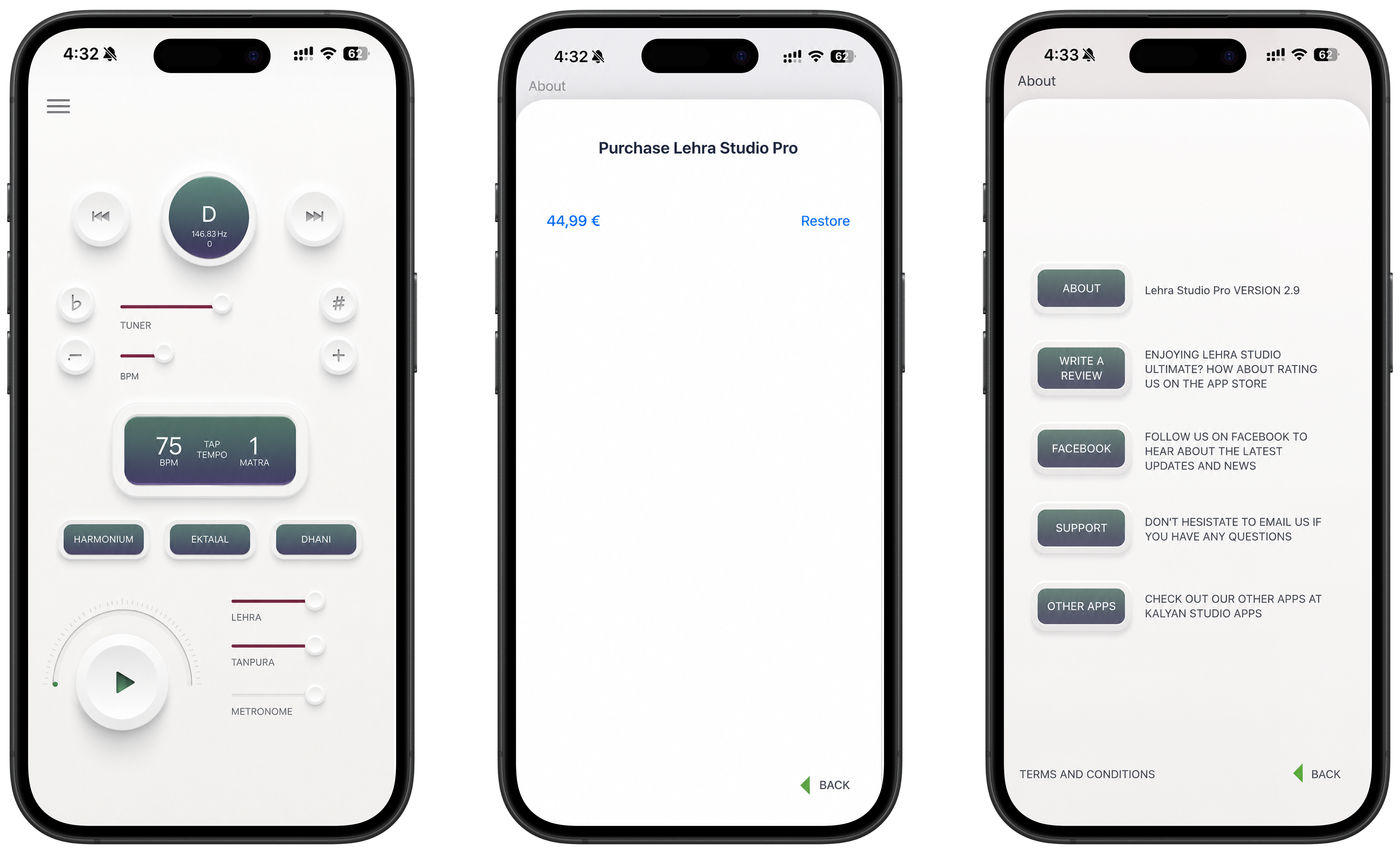
Kalyan Studio Apps is a native iOS music practice suite for Indian classical music and dance accompaniment. One shared Objective-C/Objective-C++ project powers multiple app variants, each with its own bundle ID, catalog, audio library, product ID, resources, and App Store identity.
The main issue was a paid-app-to-freemium migration. Lehra Studio Pro had previously been a paid app, then moved to a free app with a lifetime non-consumable IAP. Around 2,500 legacy paid-app users still deserved lifetime access, but normal Restore Purchases could not restore an app purchase because it only restores IAP transactions.
What I changed
- Added a Swift StoreKit 2 bridge and exposed it to the existing Objective-C IAP manager.
- Centralized product loading, purchase, restore, entitlement checks, transaction updates, and error handling.
- Implemented legacy paid-app ownership detection using StoreKit 2 app transaction data and original purchase dates.
- Preserved normal non-consumable IAP behavior for new users.
- Added entitlement caching, explicit states, duplicate-operation prevention, and safer alert timing.
- Improved retry/error mapping for transient App Store, Apple Media Services, and network failures.
- Reorganized a large Xcode project into clearer source, audio, target, config, third-party, and test areas.
- Added Firebase Analytics for instrument, taal, raag, playback start/stop, BPM, duration, and stop reason.
- Added plist-driven color metadata so catalog entries can be highlighted without hardcoded UI changes.
Audio and catalog work
The apps generate lehra/accompaniment playback. The audio engine combines WAV playback, tanpura looping, tempo control, pitch shifting, BPM-specific slices, beat/cycle synchronization, metronome accents, and level analysis.
The catalog is data-driven: instrument to taal to raag to file metadata. I helped make audio-library replacement and catalog expansion more repeatable by documenting how file names, Xcode references, and plist values need to stay aligned.
Outcome
The StoreKit 2 migration shipped, legacy paid-user restoration worked for contacted production users, and the purchase/restore layer became more reliable and maintainable.
The client also gained clearer project organization, safer audio update guidance, catalog color support, and analytics visibility into which musical content users actually practice with.
Technical notes
The key product nuance was that legacy app ownership and IAP ownership are not the same entitlement source. The implementation keeps those paths separate: StoreKit 2 current entitlements cover the non-consumable IAP, while AppTransaction original purchase data covers users who bought the paid app before the freemium switch.
Resources
Project links


Contact
Need this kind of app work?
Tell me what you’re shipping, stabilizing, or modernizing.
Dan Kurman · Daniyar Kurmanbayev